About Riichi Mahjong
Riichi (pronounced Ree-chee in Japanese, often pronounced Reech by English-speaking players) is the Japanese version of Mahjong. “Riichi” literally means “to declare ready” or “to be ready.”
While the core game remains the same, several organizations and professional leagues have developed their own rulesets over the years. The most prominent include the World Riichi Championship (WRC), European Mahjong Association (EMA), 101 Kyōgi Renmei, Japan Professional Mahjong League (JPML), and M.League.
These rulesets, along with numerous other organizational, local, regional, and house variations, represent the broad range of rules and variations that players may encounter when playing Riichi Mahjong.
About Riichi Rich Handbook
This handbook brings together the rules and variations from different Riichi rulesets and presents them in a simple, easy-to-understand format for learning and playing Riichi Mahjong. The terminology used throughout this handbook is intentionally kept simple and familiar, keeping in mind your existing understanding of Traditional Indian Mahjong and Taiwanese Mahjong. Many of the terms used in these styles are already familiar to you, so we use them wherever they help make the concepts easier to understand. Materials
Why 136? The focus of this handbook is to help you understand and enjoy the concepts of Riichi Mahjong, rather than spend valuable time learning Japanese vocabulary. Wherever possible, Japanese terms are included in brackets for reference.
A complete list of Riichi terminology, along with the corresponding Japanese names and pronunciations, is provided at the back of the handbook
Materials
Riichi Mahjong is played with 136 tiles and does not use Flower or Season tiles. In the late 19th and early 20th centuries, different Chinese forms of Mahjong used different tile configurations. Some had 136 tiles, while others included Flowers and Seasons. W. H. Wilkinson noted that a Chinese set from 1893 had no Flowers or Seasons, while a Shanghai set from 1909 did. He could not determine when or by whom these tiles were introduced.
When Mahjong reached Japan in the early 20th century, it developed along its own path and eventually standardized around the 136-tile set.
The idea that removing Flowers and Seasons was intended to reduce the element of luck is largely a modern interpretation, rather than an established historical reason. Their absence does, however, mean that Riichi places greater emphasis on tile efficiency, hand construction, reading opponents, risk management and decision-making.
Luck still remains an important part of Riichi as tiles are drawn randomly and Dora can significantly increase the value of a hand, sometimes dramatically changing the outcome of a game.
Equipment Required
136 Mahjong tiles, Mahjong mat, Dice, Scoring sticks, East Indicator(optional)
Rulers — recommended for managing the larger Taiwanese-style Mahjong tiles used in the game.
Table Setup
The Tiles
Riichi Mahjong is played with 136 tiles, consisting of 34 different tile types, with four copies of each tile. Flower and Season tiles are not used.
Building the Wall
Each player builds a wall of 17 stacks, with 2 tiles in each stack, giving each player 34 tiles. The four walls are then joined to form the complete table wall.
Determining the Dealer and Starting Point/ Rolling the Dice
The dice are used to determine the seating, the dealer (East), and the point at which the wall is broken. The players roll the dice to determine who will be East. East rolls the dice to determine where the dealing begins. The dealer counts along the wall according to the dice result and breaks the wall at that point.
Live Wall and Dead Wall (Wanpai)
The tiles after the break form two sections:
Live Wall: The tiles from which players normally draw during the game.
Dead Wall: A reserved section of 14 tiles used primarily for Kan draws and Dora indicators. Once the live wall is over, the game is a draw, you don’t move to the dead wall like other styles.
The game begins with East receiving 14 tiles, while the other three players receive 13 tiles. East then makes the first discard.
Kawa (Discarded Area)
The area in front of each player where they place their discarded tiles in neat rows of six. The seventh tile is placed in the next row.
Objective of the Game
The objective of Riichi Mahjong is to complete a winning hand and declare Mahjong.
A standard winning hand consists of 4 Sets of 3 tiles + 1 Pair of 2 identical tiles = 14 tiles.
A Set can be one of the following:
Chow (When you declare its ‘Chi’, the set is called ‘Shuntsu’): Three consecutive tiles of the same suit
Example: 4-5-6 Bamboo
Pung (When you declare its ‘Pon’, the set is called Kōtsu): Three identical tiles
Example: East-East-East
Kong (When you declare its ‘Kan’, the set is called Kantsu): Four identical tiles
Example: 5-5-5-5 Circles
The remaining two identical tiles form the Pair (Toitsu).
Note: A Kong contains 4 tiles but counts as one Set (of 3). When a Kong is formed, the player draws a replacement tile, keeping the winning hand at 14 tiles
Rounds:
Hanchan is a complete Riichi Mahjong game consisting of the East and South rounds.
Whereas Isshō is all 4 rounds.
East Round: Tonba (Ton)
South Round: Nanba (Nan)
West Round: Shaaba (Shaa)
North Round: Peiba (Pei)
The Yaku (Set / Combination / Hand) Requirement
Completing the structure of a winning hand is not enough. In Riichi, the hand must also contain a Set / Combination / Hand (Yaku) that gives at least one Han (Double) — this is a must-have winning condition.
This is similar to the concept used in Indian Traditional Mahjong – West Round (Goulash).
A Pung of Red Dragons is a Set (Yaku) and gives a player 1 Double (Han).
Likewise, if a player has three concealed Pungs, which is a Combination (Yaku), in Riichi, they get 2 Doubles (Han), unlike in Goulash, where the player gets 1 Double (Han).
In the same way, if a player has an all-Pung hand in the same suit, which is a Hand (Yaku), in Riichi, they get 8 Doubles (Han) if the hand is concealed and 7 Doubles (Han) if it is exposed, unlike Goulash, where the player gets 3 Doubles (Han).
There are also various special winning hands, as not every winning hand follows the standard 4 Sets + 1 Pair structure. Some special hands have their own unique formations, such as:
Seven Pairs — This is similar to NICO NICO in Taiwanese Mahjong minus the set of 3.
Thirteen Orphans — This is very similar to the namesake hand in Taiwanese Mahjong, minus the set of 3.
These special hands will be explained at a later stage.
Dora
Dora Indicator is exposed before the 1st discard, it’s the third tile on the dead wall from left. Dora is the +1 of the Dora Indicator it gives you extra hans, it’s a bonus han not counted as base Yaku han. Active dora comes from:
- The initial dora indicator.
- Kan dora indicators. I.e. dora indicators revealed for each Kan, whether the Kan was made by the winning player or by another player. No kan dora indicators are revealed for a robbed kan.
- Ura/ KanUra dora indicators. I.e. dora indicators beneath other active dora and kan dora indicators; only if the winning player has declared Riichi.
- Red Dora – Red tiles (1 tile of 5 in each suit) gets you a bonus.
The winning player gets one han (bonus doubles) for each dora in their hand. If several dora indicators point to the same tile, the dora is counted for each indicator.
For example, if the initial dora indicator is a 7 of dots, and a kan dora indicator is also a 7 of dots, and the winning player has an 8-8-8 dots PON in their hand, then they have 6 dora, giving 6 han.
Scoring
In Riichi scoring, the score is calculated using two parameters – Fu (Minipoints) and Han (Double), which is very similar to the Indian Traditional West Round (Goulash) system of Points and Doubles.
Score calculation is a 6-step process: the first 5 steps are for Han (Doubles) calculation, and the 6th step is for Fu (Minipoints) calculation. If you follow these steps one by one, you will never forget to count the correct number of doubles.
Start with Han (Doubles)
- Hand Han (Doubles)) – There can be multiple Hand Doubles, such as Semi-Pure and Terminals or Semi-Pure and All Pong, at the same time.
- Combination Han (Doubles) – Again, there can be multiple Combination Doubles, such as 3 Concealed Pons and Little Dragons, at the same time.
- Set/Meld Han (Doubles) – There can also be multiple doubles, such as a Pong of Red Dragons along with a Pong of the Round Wind.
- Special Han (Doubles) – This category can also have more than one double, such as declaring Riichi and winning Ippatsu, along with Robbing a Kong.
- Bonus Han (Doubles)
- Dora
- Kan Dora
- Ura-Dora / Kan Ura-Dora, if Riichi was declared
- Red 5s (Aka-Dora)
- Fu (Minipoints)
Minipoints are cumulative unless specified otherwise.
|
Situation |
Fu (Minipoints) |
Description |
Remarks |
|
Winning |
20 |
To Mahjong |
|
|
Winning on a closed hand |
10 |
+10 points to Mahjong on a concealed hand, either self-pick or discarded. |
|
|
Winning by self-draw |
2 |
Not counted in case of Pinfu yaku. |
|
|
Edge wait |
2 |
Winning on the 3 or 7 tile of an 1-2-3 or 7-8-9 sequence. |
True Single Wait in Taiwanese |
|
Middle wait |
2 |
Winning on the central tile of a sequence. |
|
|
Pair wait |
2 |
Winning on a tile completing a pair |
|
|
Seven pairs |
25 |
No other minipoints are added. No rounding up. |
NICO NICO (less Pung) in Taiwanese |
|
Open pinfu |
10 |
Awarded when an open hand is worth no minipoints beside the 20 minipoints for winning. |
|
Additional Minipoints are given for Pairs(Toitsu), Pongs(Pon) and Kongs(Kan) defined as below, which is similar to Goulash:
|
Tile Type |
Exposed Pong |
Concealed Pong |
Exposed Kong |
Concealed Kong |
Pair |
|
Value Honours (Dragons, Seat Wind & Round Wind) |
4 |
8 |
16 |
32 |
2* |
|
Non-Value Honours (Nor the Round Wind neither the Seat Wind) |
4 |
8 |
16 |
32 |
0 |
|
Terminals |
4 |
8 |
16 |
32 |
0 |
|
Minors – Numbers 2–8 |
2 |
4 |
8 |
16 |
0 |
*No Additional points for having same round and wind seat, though some rule sets do provide additional 2 points for the same.
If the winning tile completes a pon, it counts as a concealed pon in case of self-draw, but treated as an exposed pon in case completed with a discard, similar for a Kan.
Payment
Formula:
Payment = Minipoints* 2^(Double+2)
Points are always rounded off to the next highest 10’s, for example a 22 point will be raised to 30 points.
Example: Fu = 50, Han = 2
Payment = 50 * 2 ^ ( 2 + 2 ) = 50 * 16 = 800
Yaku
• Several yaku (pattern/combination) require the hand to be closed.
Every Yaku gives a Han, you can consider it as a ‘double’ in Indian Traditional Goulash, like we need 3 doubles to Mahjong in Goulash, here we need at least 1 Han Yaku.
• When a closed hand is won by calling a tile the last group or pair is considered to be exposed, but the hand is still closed.
• Yaku are cumulative unless specified otherwise.
• There are 39 Yakus (1 Han – 11, 2 Han – 11, 3 Han – 3, 5 Han – 1, 6 Han – 1 and 12 Yakuman giving table limit Hans)
• 33 Yakus are similar to Taiwanese, 6 are new.
One Han (Double) Yaku
1) RIICHI — [The HAND must be CLOSED]
The Riichi yaku is awarded to a player who declares riichi (bets 1000 when in tenpai) and wins. Riichi tiggers all Doras to be open. (Probability : 42%)
2) IPPATSU — [The HAND must be CLOSED]
Ippatsu is awarded to a player who declares Riichi and wins before their next discard, as long as no tile calls and no KAN declarations have been made in between. Riichi declarations don't break Ippatsu. Additional 1 han is provided for the Riichi yaku. (Probability : 9%)
3) FULLY CONCEALED HAND — MENZEN TSUMO— [The HAND must be CLOSED]
Fully Concealed Hand is awarded for winning by self-draw with a hand composed entirely of concealed groups and pairs. (Probability : 17%)
4) ZERO FU — PINFU — [The HAND must be CLOSED]
Zero Fu is awarded for winning on a closed hand having four CHI and a PAIR that is either of a suit tile or a non-value honour; the winning tile must complete a CHI with a two-sided (Ryanmen) wait. (Probability : 20%)
The hand score is 20 minipoints if won be self-draw, or 30 minipoints if won by calling a tile.
Note: The winning tile must be clearly identifiable when a player declares Mahjong, as it may affect the determination of certain Yaku and Fu.
5) BROTHER SHEUNGS — IIPEIKŌ — [The HAND must be CLOSED]
Brother Sheungs is awarded for having two CHI of the same numbers in the same suit. (Probability : 4%)
6) NO TERMINALS & HONOURS — TAN'YAO
No Terminals & Honours is awarded for a hand composed entirely of (any) suit tiles numbered from two to eight. (Probability : 23%)
7) VALUE HONOUR — YAKUHAI
Value Honour is awarded for having a PON or KAN of dragons, the player’s seat wind or the round wind.
Which is same as Indian Traditional West Round - Goulash
Multiple Yakuhai combine. If the player’s seat wind is the same as the round wind, a PON or KAN of this wind scores Yakuhai twice. (Probability : 15%)
8) ROBBING A KONG — CHANKAN
Robbing a Kong is awarded to a player winning by calling the tile an opponent uses to promote a KAN. Since the KAN has not been completed, no kan dora indicators are revealed for it. It's forbidden to rob a concealed KAN, even to win with the Thirteen Orphans yaku. (Probability : 0.05%)
9) AFTER A KONG — RINSHAN KAIHŌ
After a Kong is awarded for winning on the replacement tile drawn after declaring a KAN. It counts as a self-drawn win; the two Fu for winning by self-draw are awarded. Since the KAN has been successfully made, a kan dora indicator is revealed for it. (Probability : 0.3%)
10) UNDER THE SEA — HAITEI
Under the Sea is awarded for winning by self-draw on the last tile from the live wall, i.e. when there are no tiles left in the live wall. If the last tile is a replacement tile drawn after a KAN, only the yaku "After a Kong" will be scored. I.e. you cannot score Haitei and After a Kong together. (Probability : 0.3%)
11) UNDER THE RIVER — HŌTEI
Under the River is awarded for winning by calling the tile discarded after the last tile of the wall, i.e. when there are no tiles left in the live wall. It does not matter if the last tile of the wall was drawn from the live or dead wall. (Probability : 0.6%)
Two Han (Double) Yaku
1) DOUBLE RIICHI — DABURU RIICHI— [The HAND must be CLOSED]
Double Riichi is awarded to a player who declares Riichi on their first discard, as long as no tile calls i.e. picked from the discard or concealed KAN declarations have been made before. Double Riichi does not combine with the Riichi yaku. (Probability : 0.21%)
2) SEVEN PAIRS — CHIITOITSU— [The HAND must be CLOSED]
Seven Pairs is awarded for having seven different pairs. Having two identical pairs invalidates this yaku. Seven Pairs always scores a total of 25 minipoints. (Probability : 2%)
3) PURE DRAGON — KKITSŪKAN / ITTSŪ — [Worth 1 HAN if the HAND is OPEN]
Pure Dragon is awarded for having three CHI numbered 1-2-3, 4-5-6 and 7-8-9 in the same suit. (Probability : 2%)
4) 3 SETS OF SISTER SHEUNGS — SANSHOKU DŌJUN — [Worth 1 HAN if the HAND is OPEN]
3 sets of Sister Sheungs is awarded for having three CHI of the same numbers, one in each suit. (Probability : 3.4%)
5) 3 SETS OF SISTER PONGS — SANSHOKU DŌKŌ
3 sets of Sister Pongs is awarded for having three PON or KAN of the same numbers, one in each suit. (Probability : 0.05%)
6) ALL PONG HAND — TOITOI
All Pong hand is awarded for having four PON or KAN and a pair. (Probability : 3.1%)
7) THREE CONCEALED PONGS/KONGS — SAN'ANKŌ
This yaku is awarded for having three concealed PON or KAN. (Probability : 0.7%)
8) THREE KONGS — SANKANTSU
This yaku is awarded for having three KAN. (Probability : 0.005%)
9) TERMINALS & HONOURS — CHANTA — [Worth 1 HAN if the HAND is OPEN]
Terminals & Honours is awarded if all groups and the pair contain at least one terminal or honour tile. The hand must have at least one CHI and at least one honour tile. (Probability : 1%)
10) ALL PONGS OF TERMINALS & HONOURS* — HONRŌTŌ
All Pongs of Terminals & Honours is awarded for a hand composed entirely of terminal and honour tiles. The hand must have at least one set of terminal tiles and at least one honour tiles. Add two han for All Pong Hand or *Seven Pairs. It doesn’t combine with Chanta. (Probability : 0.05%)
11) LITTLE DRAGONS — SHŌSANGEN
Little Dragons is awarded for having two PON or KAN of dragons and a PAIR of dragons. Add two han for the individual PON or KAN of dragons (as Value Honours). (Probability : 0.11%)
Three Han (Double) Yaku
1) DOUBLE BROTHER SHEUNGS — RYANPEIKŌ — [The HAND must be CLOSED]
Double Brother Sheungs is awarded for having four CHI forming two independent Brother Sheungs. The Brother Sheungs can be either of different or the same numbers and suits. (Probability : 0.11%)
Double Brother Sheungs does not combine with Brother Sheungs and Seven Pairs.
2) SEMI PURE — HON'ITSU — [Worth 2 HAN if the HAND is OPEN]
Semi Pure is awarded for a hand composed entirely of tiles from one single suit and honours. The hand must have at least one suit tile and one honour tile. (Probability : 6.3%)
3) TERMINALS ONLY — JUNCHAN — [Worth 2 HAN if the HAND is OPEN]
Terminal Only is awarded if all groups and the pair contain at least one terminal, without any honour tile. The hand must have at least one CHI. (Probability : 0.34%)
Five Han (Double) Yaku
1) BLESSING OF MAN — RENHŌ — [The HAND must be CLOSED]
Blessing of Man is awarded to a player who wins by calling a tile before their first draw, as long as no tile calls or concealed KAN declarations have been made before. Riichi declarations don't break Blessing of Man. Blessing of Man does not combine with other yaku and dora. If the hand is worth more without counting Blessing of Man, the highest-scoring possibility must be chosen. (Probability : 0.05%)
Six Han (Double) yaku
1) PURE SUIT HAND — CHIN'ITSU — [Worth 5 HAN if the HAND is OPEN]
Pure Hand is awarded for a hand composed entirely of tiles from one single suit, without any honour tile. (Probability : 0.85%)
Yakuman (Big Hands)
Table Limit
1) BLESSING OF HEAVEN — TENHŌ — [The HAND must be CLOSED]
Blessing of Heaven is awarded to the East player if they win by self-draw/dealt on the initial deal, provided they have not made a concealed KAN before. (Probability : 1 in Million)
2) BLESSING OF EARTH — CHIHŌ — [The HAND must be CLOSED]
Blessing of Earth is awarded to a non-East player who wins by self-draw on their first draw, as long as no tile calls or concealed KAN declarations have been made before. Riichi declarations by other players don't break Blessing of Earth. (Probability : 1 in Million)
3) THIRTEEN ORPHANS — KOKUSHI MUSŌ — [The HAND must be CLOSED]
Thirteen Orphans is awarded for having one of each of the thirteen different terminal and honour tiles, plus one extra terminal or honour tile.
The hand can be completed on any tile; it does not need to be waiting on thirteen different tiles. It's forbidden to rob a concealed KAN to win with the Thirteen Orphans yaku. (Probability : 1 in 3,300)
4) NINE GATES — CHŪREN PŌTO — [The HAND must be CLOSED]
Nine Gates is awarded for having the tiles 1, 1, 1, 2, 3, 4, 5, 6, 7, 8, 9, 9, 9 in a single suit, plus one extra tile of the same suit. The hand can be completed on any tile; it does not need to be waiting on nine different tiles. Nine Gates is not valid if the player declares a KAN. (Probability : 1 in 330,000)
5) ALL GREEN — RYŪIISŌ
All Green is awarded for a hand composed entirely of tiles among the 2, 3, 4, 6, 8 of bamboo and the Green dragon. The hand is not required to include the Green dragon. The actual colour of tiles in the mahjong set does not matter; all and only the tiles listed above are valid for the All Green yaku. (Probability : 1 in 100,000)
6) FOUR CONCEALED PONGS — SŪANKŌ — [The HAND must be CLOSED]
This yaku is awarded for having four concealed PON or KAN. It must be won by self-draw, or by calling a tile to complete the pair. (Probability : 1 in 5,000)
7) FOUR KONGS — SŪKANTSU
This yaku is awarded for having four KAN. A player feeding the last KAN may be subject to liability payment. (Probability : 1 in Million)
8) ALL PONGS OF TERMINALS ONLY — CHINRŌTŌ
Terminals Only is awarded for a hand composed entirely of terminals, without any honour tile. (Probability : 1 in 50,000)
9) ALL HONOURS — TSŪIISŌ
All Honours is awarded for a hand composed entirely of honour tiles. (Probability : 1 in 33,000)
10) BIG DRAGONS — DAISANGEN
Big Dragons is awarded for having three PON or KAN of dragons. A player feeding the last PON or KAN of dragons may be subject to liability payment. (Probability : 1 in 10,000)
11) LITTLE WINDS — SHŌSŪSHII
Little Winds is awarded for having three PON or KAN of winds and a PAIR of winds. (Probability : 1 in 50,000)
12) BIG WINDS — DAISŪSHII
Big Winds is awarded for having four PON or KAN of winds. A player feeding the last PON or KAN of winds may be subject to liability payment. (Probability : 1 in 200,000)
Mahjong
Ron: To declare Mahjong on a discarded tile
Tsumo: To declare Mahjong on a self-pick
What happens when more than 1 person declare Ron Mahjong?
When 2 players declare Mahjong
Option 1: Double Ron — 2 players win (Default)
Example:
East discards 5 pin
South → Ron
West → Ron
Both players win and are paid separately by East depending upon the hands.
So, if South's hand is worth 8,000 and West's is worth 12,000, East pays South 8,000 + West 12,000 = 20,000.
Option 2: Only closest player wins (Atamahane / Head-bump)
When 3 players declare Mahjong
Option 1: Same as Option 1 when 2 players Ron, here the 4th players pay to other 3 players.
Option 2: Only closest player wins (Atamahane / Head-bump)
Option 3: Abortive Draw - the hand is stopped before a normal win or exhaustive draw, because a specific exceptional situation has occurred (Default). The hand is redealt.
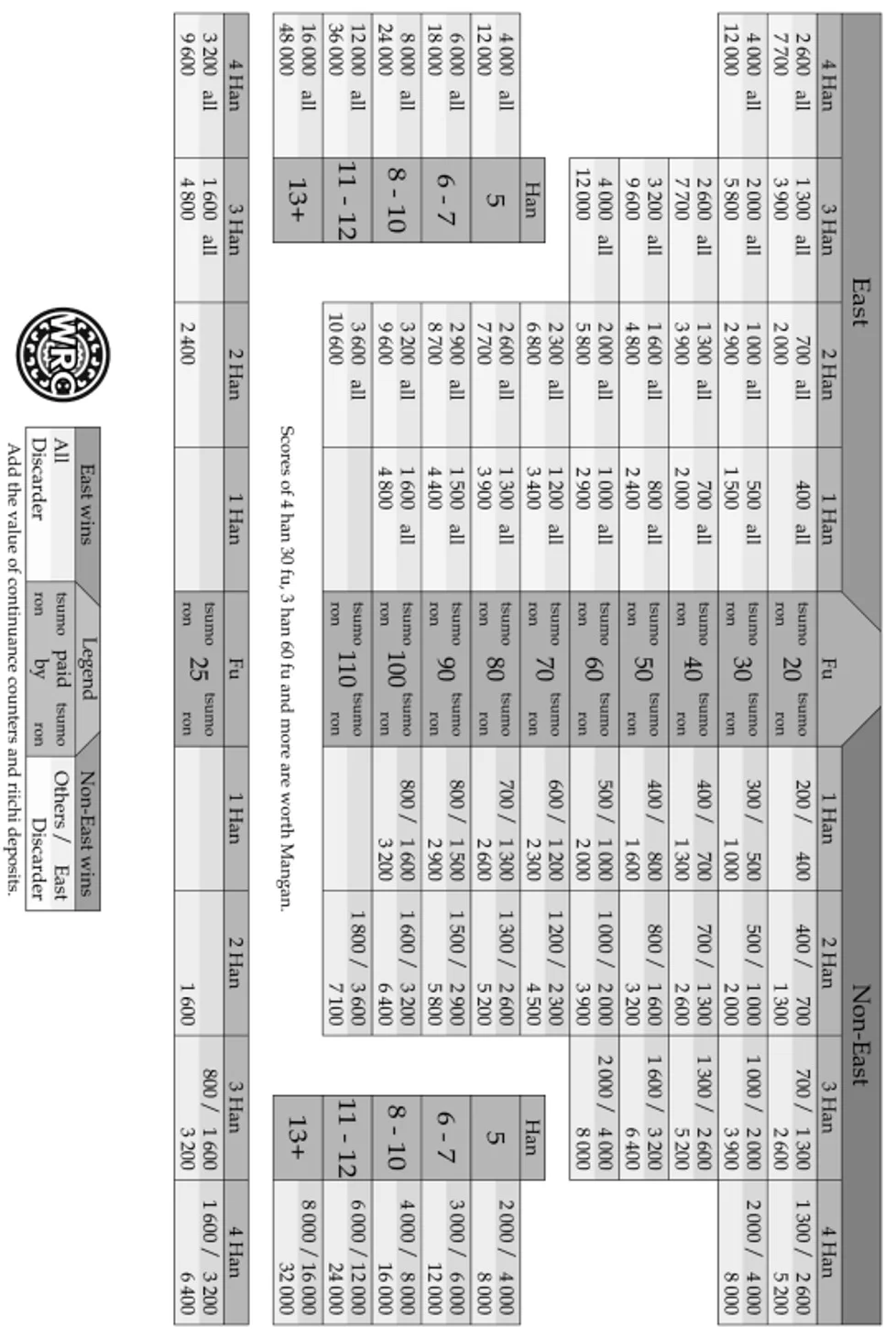
Other Important Rules
Furiten
If you have previously discarded a tile that could have completed your hand at any point during the game, you cannot declare Ron on the same tile.
|
Type |
When it happens |
How long it lasts |
|
Permanent Furiten |
You have discarded a tile that is one of your current winning tiles Eg: You have 4p5p and you are waiting for 3p. Your previous discards include 3p. Cannot Ron. Also, cannot Ron on 6p. Can do Tsumo |
Until your hand changes / you are no longer waiting on that tile |
|
Temporary Furiten |
You had a chance to Ron but chose not to call Ron Eg: You're waiting on 3p. West discards 3p. You could legally Ron, but you choose not to. You are now temporarily Furiten. On your next turn when you draw Furiten ends |
Until your next draw |
|
Riichi Furiten |
You are in Riichi and pass on a winning discard Eg: You have declared Riichi and are waiting on 3p. West discards 3p.You don't call Ron. Because you're already in Riichi, you become Riichi Furiten for the rest of the hand. You can no longer Ron on 3p—or any of your winning tiles—but you can still Tsumo. |
For the rest of the hand |
Honba
Honba is a continuation counter used to add a fixed bonus to the payments in the next hand. Think of it as a “carry-over counter.
1 Honba is added when the below conditions are there:
- The dealer wins and remains dealer.
- The hand ends in an exhaustive draw (the wall runs out).
0 Honba → dealer wins → next hand = 1 Honba
If the dealer wins again:
1 → 2 Honba, there is no maximum limit. For Casual play one can keep the limit upto 3.
1 Honba = 300 points. Remember it’s not Han or Fu.
Ron
The discarder pays 300 × number of Honba
Example: 2 Honba
Normal Ron = 8,000 || Honba = 2 × 300 = 600 || Total = 8,600
Tsumo
Each opponent pays 100 × number of Honba
Example: 2 Honba, total 2*100*3 = 600, normal Tsumo:
East normally pays 4,000 → 4,200, Honba doesn’t double for East.
West normally pays 2,000 → 2,200
North normally pays 2,000 → 2,200
Note: Round starts with 2 Honba → North wins, gets 2 Honba payment → Reset to 0 → East wins → 1 Honba → Exhaustive draw → 2 Honba → South wins, gets 2 Honba payment → Reset to 0
Liability Payments
Liability payment (Pao / Sekinin-barai) works by changing who pays the Yakuman, not by changing the Yakuman's value. Pao applies to Big Dragons (Daisangen), Big Winds (Daisuushii), and Four KANs (Suu Kantsu).
Situations:
1. Pao + Tsumo
Suppose:
East has already exposed White PON + Green PON
West discard Red || East calls Pon → Daisangen is now guaranteed
East later Tsumos Daisangen. A dealer Yakuman is 48,000.
Normally, East's Tsumo would be paid by all three opponents.
But because West gave the Red Dragon, it is liable to pay the entire 48,000:
Remember: Pao + Tsumo = liable player pays the entire Yakuman.+ Honba
2. Pao + Ron
Let’s stay with the same example:
East has already exposed White PON + Green PON
West discard Red || East calls Pon → Daisangen is now guaranteed
South later discards the winning tile.
East wins by Ron. East's dealer Yakuman = 48,000.
The 48,000 is split equally between: Liable player (West) = 24,000 & Final discarder (South) = 24,000
Note: For a Ron, the final discarder pays the Honba, not the liable player.
Noten Payment
Noten payment is a points payment made when a hand ends in an exhaustive draw and some players are Tenpai while others are Noten.
Tenpai = one tile away from a complete winning hand.
Noten = not Tenpai.
The total payment is 3,000 points, redistributed between the Tenpai and Noten players.
|
Tenpai players |
Noten players |
Each Tenpai receives |
Each Noten pays |
|
1 |
3 |
+3,000 |
−1,000 |
|
2 |
2 |
+1,500 |
−1,500 |
|
3 |
1 |
+1,000 |
−3,000 |
Penalties
Here is an exhaustive list of fouls and their corresponding penalties. Table rules apply.
Minor – An error that does not materially affect the outcome of the game.
Dead Hand – An error that affects the player's ability to win or otherwise impacts the outcome of the hand. Draw and Discard tile, cannot change the tile. Doesn’t have any penalty.
Chonbo – A serious error that has a significant impact on the outcome of the hand or makes it impossible for the hand to continue fairly.
· The current hand ends immediately.
· No one wins that hand.
· The offending player receives the Chonbo penalty – Deduct 30 points from Tournament points. For Casual play a 1000 points penalty can be imposed, to be paid to every player.
· The hand is restarted/redealt.
· The dealer generally remains the dealer because there was no normal win.
· No Honba added or removed
· Riichi sticks placed during that hand are returned to their owners
|
Degree |
Foul / offence |
Typical penalty |
What it means / small example |
|
Minor |
Minor dealing error |
Warning / correction |
A tile is accidentally exposed during the deal but can be corrected without affecting information or play. |
|
|
Minor tile-placement error |
Warning / correction |
You place a discard incorrectly but immediately correct it. |
|
|
Minor procedural error |
Warning |
You make a small procedural mistake that does not affect another player's decision, like placing a tile anywhere on the table |
|
Dead Hand |
Too many tiles |
Dead Hand |
You draw when you already have too many tiles and the error cannot be reliably corrected. |
|
|
Too few tiles |
Dead Hand |
You fail to take a called tile and continue playing. |
|
|
Draw out of turn |
Dead Hand |
You draw before the previous player's turn has properly ended. |
|
|
Draw from wrong place |
Dead Hand / Chonbo if irreversible |
You take a tile from the wrong part of the wall and incorporate it into your hand. |
|
|
False Chi |
Dead Hand |
You announce Chi but the tiles cannot legally form a sequence. |
|
|
False Pon |
Dead Hand |
You announce Pon but don't actually have the required pair. |
|
|
False Kan |
Dead Hand |
You announce a Kan that isn't legally possible. |
|
|
Empty call |
Dead Hand |
You announce Chi/Pon/Kan but don't complete the call properly. |
|
|
Illegal Chi/Pon/Kan |
Dead Hand |
You take a discard that cannot legally be used for that call. |
|
|
Kuikae |
Dead Hand in rulesets prohibiting it |
You call 123 and immediately discard the 3 to effectively replace the called 3. |
|
|
Illegal call after Riichi |
Dead Hand / Chonbo depending on severity |
You attempt to make a Chi or Pon after declaring Riichi. |
|
|
Incorrect Riichi declaration |
Dead Hand / Chonbo depending on circumstances |
You declare Riichi when the hand is not actually Tenpai. |
|
|
Open Riichi when not permitted |
Dead Hand |
You declare a form of Open Riichi when the ruleset doesn't permit it. |
|
|
Incorrect sideways discard |
Warning / Dead Hand depending on circumstances |
You declare Riichi but fail to mark the Riichi discard correctly. |
|
Chonbo |
Furiten Ron |
Chonbo |
You are Furiten but nevertheless declare Ron. |
|
|
No-ten Riichi |
Chonbo |
You declare Riichi believing you're Tenpai, but your hand has no winning tile. |
|
|
Invalid Ron/Tsumo with hand exposed |
Chonbo |
You announce Ron, expose your hand and then discover that the hand isn't legal. |
|
|
Illegal winning declaration |
Chonbo |
You declare a win when the hand has no Yaku or otherwise cannot legally win. |
|
|
Illegal Kan after Riichi |
Chonbo |
You make a Kan that changes your wait after declaring Riichi. |
|
|
Illegal Kan that affects the hand |
Chonbo |
You make a Kan that is not legally permitted and the error cannot be reversed. |
|
|
Discarding from the wrong hand after Riichi |
Chonbo |
You accidentally discard a tile other than the drawn tile after Riichi. |
|
|
Serious tile exposure |
Chonbo |
You expose enough concealed tiles that the hand can no longer continue fairly. |
|
|
Major wall error |
Chonbo |
You substantially damage/rearrange the wall so that the correct draw order cannot be established. |
|
|
Irrecoverable wrong draw |
Chonbo |
You draw from the wrong location and mix the tile into your hand, making correction impossible. |
|
Tournament / disciplinary |
Repeated minor offences |
Point penalty / disciplinary warning |
You repeatedly make small procedural mistakes despite warnings. |
|
|
Slow play / excessive delay |
Point penalty / warning |
You repeatedly take unreasonable amounts of time without justification. |
|
|
Signalling / giving information |
Point penalty / disciplinary penalty |
You deliberately indicate that another player's discard is useful to you. |
|
|
Discussing your hand |
Point penalty / disciplinary penalty |
You tell another player what you are waiting for. |
|
|
Discussing another player's hand |
Point penalty / disciplinary penalty |
You tell the table that another player is probably waiting on 5-pin. |
|
|
Repeated disruptive behaviour |
Point penalty / disciplinary penalty |
Continually disrupting play after being warned. |
|
|
Late arrival |
Tournament penalty |
You arrive after the scheduled start of the match. |
|
|
Incorrect score recording |
Correction / point penalty |
You repeatedly record scores incorrectly despite correction. |
|
Severe |
Deliberate cheating |
Disqualification / ban |
Deliberately looking at another player's concealed tiles. |
|
|
Collusion |
Disqualification / ban |
Two players deliberately cooperate to affect the result. |
|
|
Deliberately revealing information |
Disqualification / severe penalty |
You intentionally show your hand to influence another player's decision. |
|
|
Manipulating tiles |
Disqualification / ban |
Deliberately marking, switching or manipulating tiles. |
|
|
Repeated serious offences |
Disqualification / ban |
Continuing serious misconduct after previous penalties. |
|
|
Threatening / abusive conduct |
Disqualification / ban |
Serious behaviour that prevents the tournament from continuing n |
Atozuke (pronunciation : Ah-toh-zoo-keh) means “adding the Yaku later.”
It refers to a situation where a player makes an open call without having a Yaku guaranteed at that point and only completes the Yaku later before winning.
Example:
You open your hand by calling Pon on a tile that does not give you a Yaku. Later, you complete a Yakuhai or another Yaku, which becomes the condition that allows you to win.
· Atozuke Ari: pronounced Ah-ree — means “yes / allowed / exists.
”The hand may win even if the Yaku is obtained only with the winning tile. Atozuke itself gives 0 Han.
· Atozuke Nashi: pronounced Nah-shee — means “no / not allowed / absent.”
That type of win is not permitted. You cannot simply say “Atozuke gives a penalty”; the normal consequence is that the hand cannot be declared a valid win.
Points to remember:
· Atozuke itself is not a Yaku
· It gives no additional Han
· It is simply a rule condition
· Most rulesets allow Atozuke, while others prohibit it.
Default : Atozuke Ari (Players decide before breaking the wall on Nashi)
Abortive Draws (tochū ryūkyoku)
|
Types |
English |
What triggers it? |
|
Kyuushū Kyuuhai |
Nine Terminals & Honors |
Player has 9+ different 1s, 9s and honours on their first turn |
|
Suufon Renda |
Four Winds |
All 4 players' first discards are the same wind |
|
Suucha Riichi |
Four Riichi |
All 4 players declare Riichi |
|
Suukaikan |
Four Kans |
4 Kans by 2+ different players |
|
Sanchahō |
Triple Ron |
3 players Ron on the same discard — only in rulesets that use it as an abortive draw |
Tournament Points System, Oka and Uma
Point System, Oka and Uma are primarily a tournament/league standings mechanism, not part of the actual hand scoring during casual play.
The points system, Oka and Uma are where different Riichi leagues can look quite different.
|
Ruleset |
Starting points |
Return / Target |
Oka (Bonus) |
Uma (Standard Score) (1st / 2nd / 3rd / 4th) |
|
WRC 2025 |
30,000 |
30,000 |
0 |
+15 / +5 / −5 / −15 |
|
EMA 2025 |
30,000 |
30,000 |
0 |
+15 / +5 / −5 / −15 |
|
M.League |
25,000 |
30,000 |
+20 added to 1st |
+30 / +10 / −10 / −30 |
|
101 |
30,000 |
30,000 |
0 |
No Oka or Uma, +1 to 1st -1 to 4th |
|
JPML Official |
30,000 |
30,000 |
0 |
Only 1 player above 30k +12 / −1 / −3 / −8 2 players above 30k +8 / +4 / −4 / −8 3 players above 30k +8 / +3 / +1 / −12 |
Starting Points – Initial points one starts with
Return/target – this is the reference point from which the final score is calculated.
Oka - the bonus created when starting points < return points. Example, in M.League 4 players start with: 25,000 × 4 = 100,000, but here the target is: 30,000 × 4 = 120,000. There's a 20,000-point difference. That 20,000 goes to the winner as Oka as 20,000/1,000 = 20 points.
Uma = Standard preset additional bonus/penalty based purely on finishing position.
Raw score = the points you physically have at the end.
For example, the exact final scores:
1st: 41,000
2nd: 34,000
3rd: 32,000
4th: 13,000
Total = 120,000, so these can be compared directly across 30,000-return systems and 25,000-start/30,000-return systems.
WRC/ EMA 2025
30,000 start / 30,000 return
Oka = 0
Uma = +15 / +5 / −5 / −15
|
Place |
Raw score |
− Starting 30,000 |
Raw points (Difference/1000) |
Standard Uma |
Final Points |
|
1st |
41,000 |
+11,000 |
+11 |
+15 |
+26 |
|
2nd |
34,000 |
+4,000 |
+4 |
+5 |
+9 |
|
3rd |
32,000 |
+2,000 |
+2 |
−5 |
−3 |
|
4th |
13,000 |
−17,000 |
−17 |
−15 |
−32 |
M.League:
25,000 start / 30,000 return. The 20,000 difference is Oka, given to 1st.
Uma: +30 / +10 / −10 / −30
Therefore, the effective placement points are:
1st +50 / 2nd +10 / 3rd −10 / 4th −30.
|
Place |
Raw score |
− Return 30,000 |
Raw points (Difference/1000) |
Placement + Uma |
Final Points |
|
1st |
41,000 |
+11,000 |
+11 |
+20+30 |
+61 |
|
2nd |
34,000 |
+4,000 |
+4 |
+10 |
+14 |
|
3rd |
32,000 |
+2,000 |
+2 |
−10 |
−8 |
|
4th |
13,000 |
−17,000 |
−17 |
−30 |
−47 |
JPML Official Rules:
It uses a floating Uma, which depends on how many players finish at or above the return point.
30,000 start / 30,000 return
Oka = 0
Uma = Only 1 player above 30k: +12 / −1 / −3 / −8 || 2 players above 30k: +8 / +4 / −4 / −8 || 3 players above 30k: +8 / +3 / +1 / −12
|
Place |
Raw score |
− Return 30,000 |
Raw points (Difference/1000 |
Floating Uma |
Final Points |
|
1st |
41,000 |
+11,000 |
+11 |
+8 |
+19 |
|
2nd |
34,000 |
+4,000 |
+4 |
+3 |
+7 |
|
3rd |
32,000 |
+2,000 |
+2 |
+1 |
+3 |
|
4th |
13,000 |
−17,000 |
−17 |
−12 |
−29 |
Terminologies
|
Traditional / Common Term |
Riichi Term |
Pronunciation |
Meaning |
|
Tile |
Hai (牌) |
High |
|
|
Mahjong Tile |
Mahjong-pai (麻雀牌) |
Mah-jong-pai |
|
|
Set / Meld |
Mentsu (面子) |
Men-tsoo |
A completed group of 3 or 4 tiles: Chow, Pung or Kong |
|
Combination |
Yaku (役) |
Yah-koo |
A qualifying pattern/condition that allows a hand to win and gives Han |
|
Pung / Pon |
Kōtsu (刻子) |
Koh-tsoo |
Three identical tiles |
|
Pung Call |
Pon (ポン) |
Pohn |
Call made to claim an opponent’s discard and form an open Kōtsu |
|
Chow / Sequence |
Shuntsu (順子) |
Shoon-tsoo |
Three consecutive tiles of the same suit |
|
Chow Call |
Chi (チー) |
Chee |
Call made to claim the immediately preceding player's discard and form an open Shuntsu |
|
Kong / Kan |
Kantsu (槓子) |
Kahn-tsoo |
Four identical tiles |
|
Kong Call |
Kan (カン) |
Kahn |
Call made to form a Kong |
|
Suits |
Shurui (種類) |
Shoo-roo-ee |
The three numbered tile families |
|
Characters / Cracks |
Manzu (萬子) |
Mahn-zoo |
1–9 of Characters |
|
Circles / Dots |
Pinzu (筒子) |
Peen-zoo |
1–9 of Circles |
|
Bamboo / Bams |
Souzu (索子) |
Soe-zoo |
1–9 of Bamboo |
|
Honours |
Jihai (字牌) |
Jee-high |
Winds & Dragons |
|
Winds |
Kazehai (風牌) |
Kah-zeh-high |
East, South, West, North |
|
East Wind |
Ton (東) |
Tohn |
East |
|
South Wind |
Nan (南) |
Nahn |
South |
|
West Wind |
Shaa (西) |
Shah |
West |
|
North Wind |
Pei (北) |
Pay |
North |
|
Dragons |
Sangenpai (三元牌) |
Sahn-gen-pie |
White, Green, Red |
|
White Dragon |
Haku (白) |
Hah-koo |
White Dragon |
|
Green Dragon |
Hatsu (發) |
Hah-tsoo |
Green Dragon |
|
Red Dragon |
Chun (中) |
Choon |
Red Dragon |
|
Pair |
Toitsu (対子) |
Toy-tsoo |
Two identical tiles |
|
Set / Group |
Mentsu (面子) |
Men-tsoo |
A completed three- or four-tile group |
|
Concealed Pon |
Anko (暗刻) |
Ahn-koh |
A concealed Pong |
|
Concealed Kan |
Ankan (暗槓) |
Ahn-kahn |
A concealed Kong |
|
Open Pon |
Minko (明刻) |
Meen-koh |
An exposed Pong |
|
Open Kan |
Minkan (明槓) |
Meen-kahn |
An exposed Kong |
|
1 |
Ichi (一) |
Ee-chee |
1 |
|
2 |
Ryan (二) |
Ryaan |
2 |
|
3 |
San (三) |
Sahn |
3 |
|
4 |
Yon (四) |
Yohn |
4 |
|
5 |
Go (五) |
Goh |
5 |
|
6 |
Roku (六) |
Roh-koo |
6 |
|
7 |
Nana (七) |
Nah-nah |
7 |
|
8 |
Hachi (八) |
Hah-chee |
8 |
|
9 |
Kyū (九) |
Kyoo |
9 |